

Issue 38 • 26-Oct-2006


 Trash talker









|
Rocket Body
Body composition basics: What is a healthy weight for you?
While the scale doesn’t lie, it doesn’t tell the whole truth either. Getting your body composition measured reveals the complete picture of healthy body weight and body-fat tissue.
The two components of body composition are fat tissue and lean tissue.
The total amount of body fat consists of essential fat and storage fat. Essential fat is fat in the marrow of bones, heart, lungs, liver, spleen, kidneys, intestines, muscles and lipid-rich tissues throughout the central nervous system. Essential fat is necessary for normal bodily function. The essential fat of women is higher than the essential fat of men because it includes sex-characteristics related to childbearing.
|
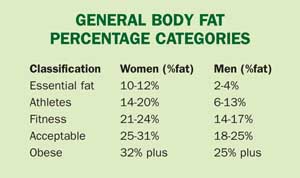
Fat that accumulates in adipose tissue is called storage fat. Storage fat is located around the internal organs and directly beneath the skin (subcutaneous fat). It provides protection, serves as an insulator to conserve body heat and is a source of stored energy.
Lean body mass represents the weight of muscles, bones, ligaments, tendons and internal organs. Since there is some essential fat in the marrow of bones and internal organs, lean body mass includes a small percentage of essential fat. Lean body mass will increase with regular strength-training exercise. Muscles, tendons and bones increase in both density and strength. Strength training improves physical capacity, improves metabolic function to enhance weight loss, reduces the risk of injury and increases performance power.
After age 20, adults who do not perform some type of strength training lose about one pound of muscle every two years. Every pound of muscle we lose lowers our metabolic rate by about 50 calories per day, and every pound of muscle we gain raises our metabolic rate by about 50 calories per day. Remember that our muscle tissue has a high energy requirement for protein synthesis, maintenance and repair.
Health practitioners agree that too much body fat is a serious health risk. Problems such as cardiovascular disease, high cholesterol, high blood pressure and many other conditions are all related to obesity.
|
Knowing your body-fat percentage can also help you determine if your weight-loss goals are realistic. Remember, weight loss doesn’t always mean fat loss. So before you decide that you need to lose “weight,” consider that weight consists of both lean body mass and body fat. Try to keep your weight-loss goals realistic and remember to keep the calorie-burning muscle and only lose the fat.
I’d love to hear about what’s working (and not working) for you. Feel free to share your stories or questions with me at editor@uptownpub.com. Ron Lopezi is the fitness director and a personal trainer at Frog’s Fitness in Mission Valley.

contact us | advertise