

Issue 43 • 04-Jan-2007


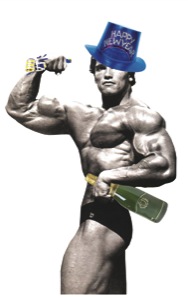
 Happy new queer!











|
Rocket Body
Now that 2006 has drawn to a close and 2007 is rushing in, it’s time to reflect on the past year. I’m sure you have had many ups and downs, many accomplishments and a few challenges. But here are a few important questions to ask yourself and reflect on: Did you have a plan? Did you set yourself up for success? Did you set goals?
For most people, the answer is no. Most people don’t sit down and come up with any kind of plan to reach any kind of goal. Most people see the end result, sprint out of the st-arting gate, jig and jag the obstacles and hope for the best. It really is like running a race with an obstacle course. Sometimes by chance it works, but in most cases it does not.
It’s important to set goals and have a plan. Here are some steps in the planning and goal-setting process. By sitting down, physically writing everything out on a piece of paper and creating a plan, you will be sure to kick off the year to a great start!
Set your goals
Setting goals is perhaps the most important part of any aspect in life. Whether it is to buy your first house, go on that long-awaited vacation or start an exercise program, setting goals gives us a road map of getting from point A to point B. Goals may be different for everybody, but pick three to focus on. Goals must be measurable and attainable. For fitness, is it to get stronger or to lose weight? Maybe it is to run your first 5K or participate in a triathlon. Whatever your goals are, sit down and write them on a piece of paper. Post them on your refrigerator, write them on your desk calendar and remember them.
Assess your starting point
One of the most important steps that is often skipped in fitness goal-setting is assessing your starting point. Again, goals must be measurable. So, by assessing your current fitness levels you get a “snapshot” of what your strengths and weakness are now. A fitness assessment will measure all components of physical fitness. Areas measured would be resting heart rate, blood pressure, weight, anthropomorphic measurements, flexibility, streng-th, body composition and cardiovascular fitness. Most gyms provide some type of fitness testing at a nominal cost. But this is the most important piece of information and the most often skipped piece you need. This is your starting point.
Know your barriers to success
Knowing what would keep you from being successful is crucial to the planning process and to your success. Do you have an injury that would prevent you from starting an exercise program? Do you have the support of a spouse? Is not having enough time a barrier? Knowing the barriers or obstacles ahead of time will allow you to make changes to your plan. If you don’t know your barriers, it can feel like you are hitting a brick wall, lead to frustration and inevitably cause you to fall off the exercise wagon. Barriers are possible to overcome. There is a solution for everything!
Plan your attack
Sit down with a calendar and lay your plan out. Plan month by month and write your workouts in as you would any other appointment in your book. This proves much more successful than just working out when you have time or when the day is over. Inevitably, things come up, life comes up and the workouts get pushed back. If you treat your workout as any other appointment, you will force yourself to stay on track. We are creatures of habit. It’s amazing how quickly time goes by, and laying out our plans forces us to stay on track.
Track your progress
Workout logs are the best way to track your progress. Time is valuable, and we want to be efficient on the workout floor and waste no time. Logs will help you stay focused and provide an exercise “to do” list. They will also keep you efficient and force you to push yourself if you see you have been doing the same weights for a long time.
Re-evaluate and then start the whole process over
You should re-evaluate your progress in approximately 90 days. Since your goals are measurable, by taking another fitness test you can see what areas have improved and what areas have not. Now is the time to make changes in your program. It is those small gains that add up to the large ones by the end of the year.
Stay motivated and have fun!
I can understand lifting heavy objects up and down multiple times and running fast in one place and going nowhere is not the most motivating or fun thing to do. But making it fun is up to you. Try group classes, get a workout partner or hire a personal trainer to keep you motivated and to keep you going.
I’d love to hear about what’s working (and not working) for you. Feel free to share your stories or questions with me at editor@uptownpub.com.

contact us | advertise